Craft · October 2026
Oud attar oil: how it is made, how it was used and how to wear it
A guide to oud oil and attar: hydrodistillation, the Kannauj tradition, the difference between dehn al oud and attar, and how to apply concentrated oud oil.
Oud oil, dehn al oud and attar
Oud oil (in Arabic dehn al oud) is the essential oil distilled from resinous agarwood. An attar, in the strict historical sense, is a natural perfume oil produced by distilling flowers or herbs and capturing their vapours in a base oil — traditionally sandalwood. In everyday use the word attar now covers alcohol-free concentrated perfume oils in general. An oud attar can therefore be pure oud oil, or a blend in which oud is combined with rose, saffron, sandalwood or other materials.
How oud oil is distilled
Resinous wood is chipped or ground, often soaked in water for days or weeks, and then hydrodistilled or steam-distilled. The yield is extremely low: many kilograms of wood may produce only a few millilitres of oil. Soaking time, distillation length, the type of still and the quality of the wood all shape the final aroma. Oils from India, Cambodia, Malaysia, Borneo, Vietnam or Thailand are often described as having distinct regional characters, although species and processing matter as much as geography.
The deg-bhapka tradition of Kannauj
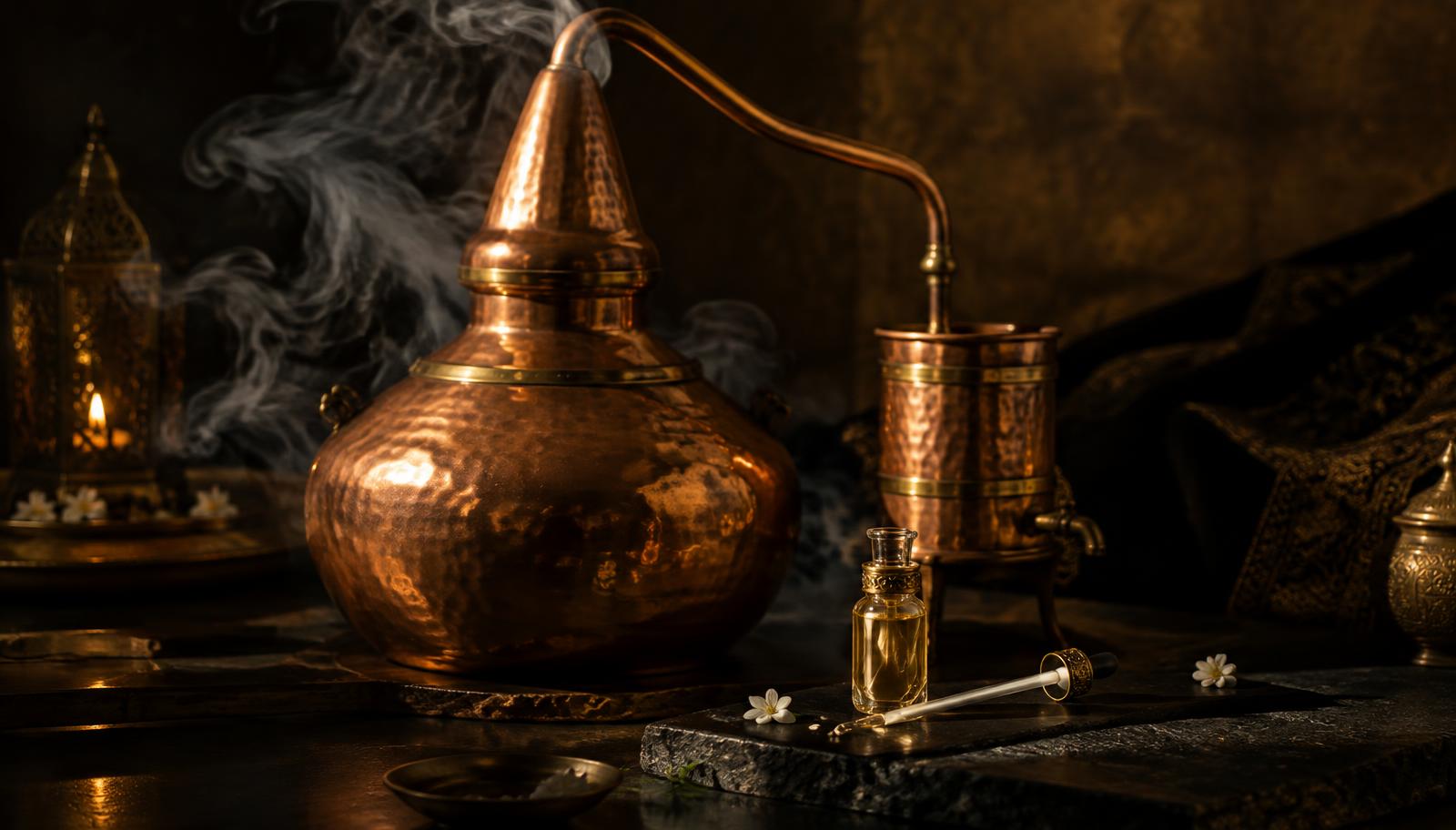
In Kannauj, in the Indian state of Uttar Pradesh, attar makers still use the deg-bhapka method: copper stills (deg) heated over wood or cow-dung fires, connected by bamboo pipes to receivers (bhapka) containing sandalwood oil. Aromatic vapours condense into the base oil over many days. The technique, documented for centuries, is one of the oldest continuous perfumery crafts in the world and illustrates how attars were made long before alcohol-based perfume became dominant.
Traditional uses
Across the Gulf, South Asia and Southeast Asia, oud oil has been applied to skin, beard and clothing on festive days, for Friday prayers and when receiving guests. Agarwood has also been used in traditional Asian medicine systems, including Ayurveda, traditional Chinese medicine and Unani. These are cultural uses: they are not evidence that oud oil treats any condition.
What science says about possible benefits
Laboratory and animal studies have reported anti-inflammatory, antioxidant, antimicrobial and sedative activity for agarwood extracts and some of their constituents. However, these results come mostly from extracts studied in vitro or in animals, not from people using perfume oil. Robust clinical evidence in humans is limited, so oud oil should be enjoyed as a fragrance, not as a remedy. Like all concentrated aromatic materials, it can irritate sensitive skin.
How to wear oud attar oil
Concentrated oud oil is used sparingly: a single touch of the dauber on the pulse points — inner wrists, behind the ears or the base of the throat — is usually enough. Allow it to warm on the skin rather than rubbing it in. Oud oil can stain light fabrics, so apply to skin first. Patch-test on a small area if you have sensitive skin, and store the bottle tightly closed, away from heat and light, where its scent can continue to mature.
Oud oil versus oud perfume spray
An oud eau de parfum is diluted in alcohol, projects more in the first hours and is easy to spray. Oud attar oil stays closer to the skin, evolves slowly and often lasts many hours. Many enthusiasts layer the two: a drop of oud oil as a base, with a spray of perfume above it.