Material · October 2026
What is oud? A history of agarwood, from sacred incense to oud perfume
Oud is the resin-rich heartwood of the Aquilaria tree. Discover where agarwood comes from, why it is so rare and how it shaped perfumery across Asia, the Middle East and Europe.
Oud in one sentence
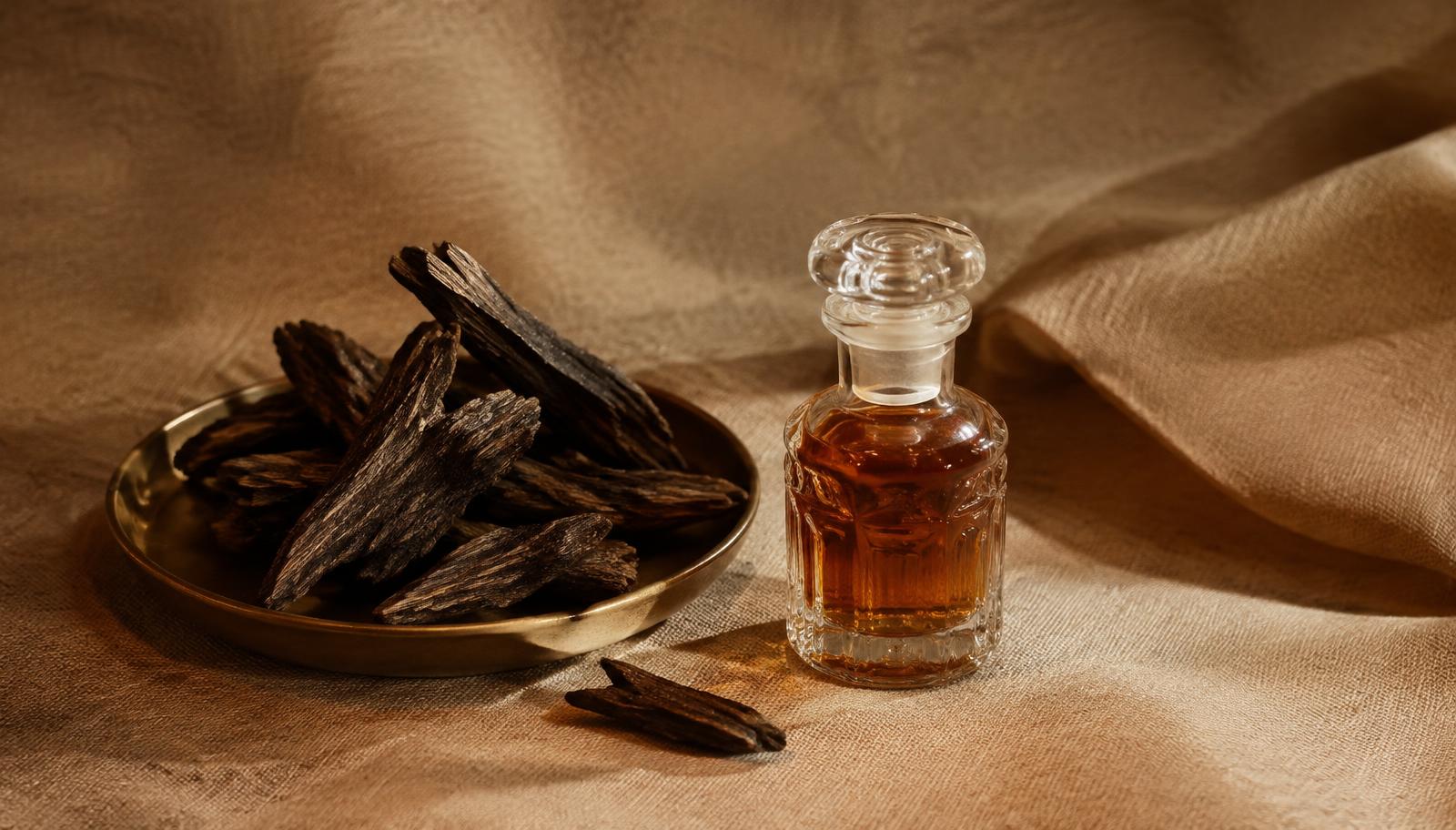
Oud — also called agarwood, aloeswood, eaglewood, gaharu or jinkoh — is the dark, aromatic resin that forms inside the heartwood of certain Aquilaria (and the closely related Gyrinops) trees, native to South and Southeast Asia. Healthy Aquilaria wood is pale and almost odourless; it only becomes agarwood when the tree responds to injury, insects or fungal infection by producing a protective oleoresin. That defensive reaction, which can take many years to develop, is the origin of every true oud perfume and oud oil.
Why agarwood is rare
Only a fraction of wild Aquilaria trees contain significant resin, and for centuries harvesters had to fell trees to find out. Overharvesting led to the listing of Aquilaria malaccensis in Appendix II of CITES in 1995, extended in 2004 to all Aquilaria and Gyrinops species. International trade is therefore regulated. Today a growing share of agarwood comes from cultivated plantations, where resin formation is induced by controlled wounding or inoculation. Cultivated oud and wild oud can smell different, and both vary widely by species, region, age and distillation.
A material with deep roots
Agarwood appears in ancient Sanskrit texts as aguru, and it has been burned as incense in Hindu, Buddhist and Taoist practice for well over a thousand years. In Japan, pieces of jinkoh and the prized kyara are appreciated in kōdō, the ceremonial art of "listening to incense", which developed in the Muromachi period. Many scholars identify the "aloes" mentioned in the Hebrew Bible (for example Psalm 45:8) and in the Gospel of John with agarwood rather than the aloe plant.
Oud in Arabian and Islamic perfume culture
The Arabic word ʿūd simply means "wood", and the material became central to perfume culture across the Arabian Peninsula. Hadith collections such as Sahih Muslim record the use of aloeswood incense, and the ninth-century scholar al-Kindī described aloeswood alongside musk, ambergris and camphor in his book on the chemistry of perfume. To this day, bakhoor and oud chips are burned to welcome guests, scent clothing and mark celebrations.
What gives oud its scent
Chemical studies show that agarwood is a complex mixture of sesquiterpenes and 2-(2-phenylethyl)chromones, compounds that are rarely found together in other natural materials. Their balance helps explain why the scent of oud is so layered: woody, balsamic, leathery, animalic, smoky, sweet or even fruity depending on the material. Because no single molecule reproduces this profile, natural oud remains highly valued, and many "oud" fragrances use accords that interpret it rather than the raw material itself.
From the East to Western niche perfumery
European perfumers began featuring oud prominently in the early 2000s, and oud has since become a signature of niche perfumery. Modern oud perfumes often pair agarwood or an oud accord with rose, saffron, amber, leather or musk, translating a traditional Middle Eastern material into contemporary eau de parfum. When choosing an oud perfume, it is worth asking whether the fragrance contains natural agarwood, an oud accord, or both.
How to recognise quality
Colour and price alone do not prove quality. Reputable sellers can describe the species, origin, whether the wood is wild or cultivated, and how the oil was distilled. Genuine oud develops slowly on skin and changes over hours. Be cautious of very cheap "pure oud" claims, since adulteration with synthetic materials or carrier oils is common in the trade.
Sources
- Hashim Y.Z. et al. (2016). Aquilaria spp. (agarwood) as source of health beneficial compounds: a review of traditional use, phytochemistry and pharmacology. Journal of Ethnopharmacology 189, 331–360.
- CITES — Agarwood-producing taxa (Aquilaria and Gyrinops spp.), Appendix II.
- Naef R. (2011). The volatile and semi-volatile constituents of agarwood, the infected heartwood of Aquilaria species: a review. Flavour and Fragrance Journal 26, 73–87.